The Essential Guide to Living in Charlotte, NC for Young Professionals
Discover Charlotte's high-energy Uptown/South End vibe: $419.8K median, 58 DOM, LYNX Blue Line, breweries, condos and 15-min CLT access.
Written ByTristan Armstead
PublishedOctober 16, 2026
UpdatedOctober 19, 2026
Armstead Realty Group is a Charlotte, NC real estate team helping buyers and sellers with finance-driven strategy, a 5% listing fee, and English, Spanish, and Tagalog service. Serving Charlotte, NC, Cramerton, NC, McAdenville, NC, Lowell, NC, Dallas, NC, Lake Wylie, SC, Mount Holly, NC, Pineville, NC, Fort Mill, SC, Monroe, NC, Tega Cay, SC, Harrisburg, NC, Gastonia, NC, Concord, NC, Huntersville, NC and Belmont, NC.
Charlotte, NC
Region
10
Villages
Charlotte has quietly become one of the Southeast's biggest magnets for early- and mid-career professionals. The region adds roughly 150 new residents per day, the metro population is closing in on 2.8 million, and the city ranks as the country's 2nd-largest banking center. Much of that momentum is concentrated in the urban core: Uptown, South End, NoDa, Plaza Midwood, and Camp North End. This guide covers what it's really like to live, buy, and commute there.
What Is It Like to Live in Uptown and South End Charlotte, NC as a Young Professional?
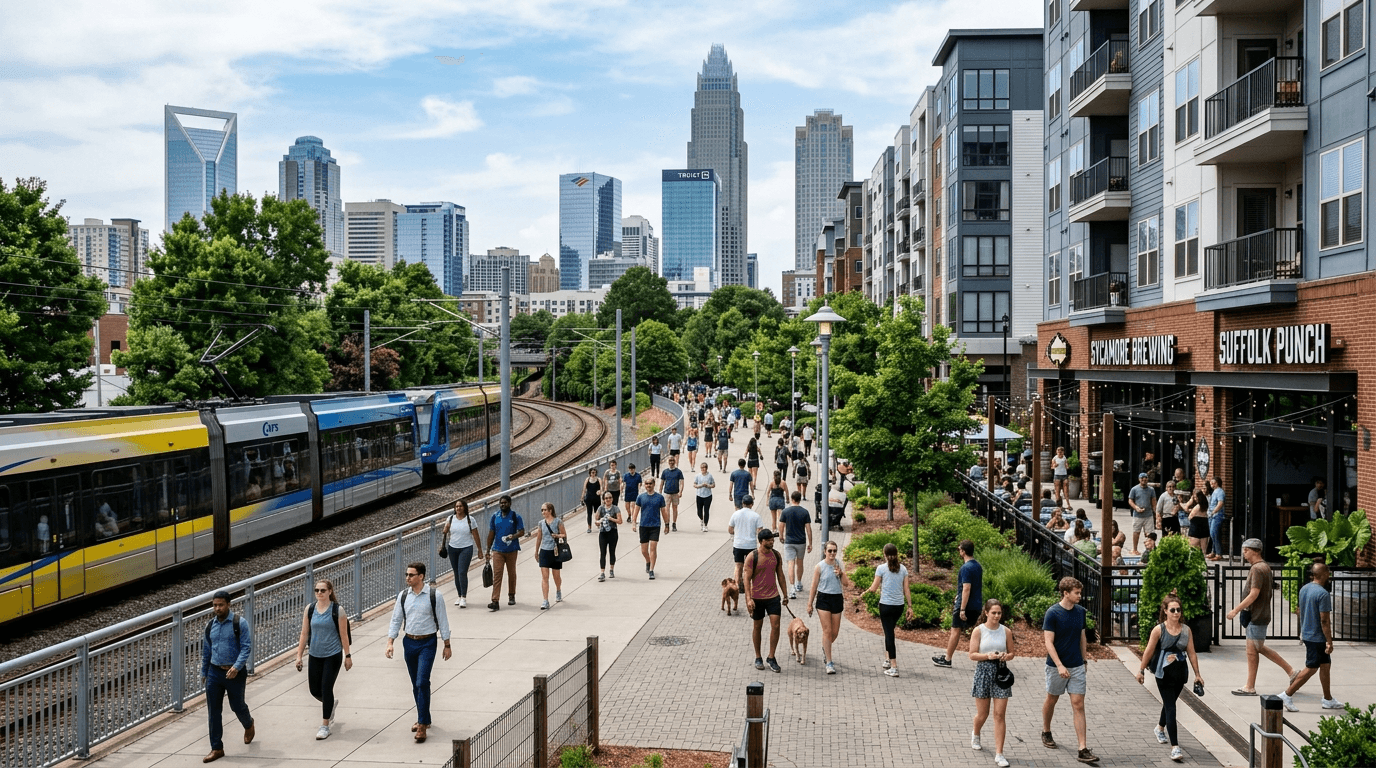
Central Charlotte runs on a day-to-night rhythm, and it's busy and social. On weekdays, the towers fill with bankers and tech workers. In the evenings and on weekends, the crowds move to patios, breweries, and rooftop bars. If you want a lively neighborhood you can get around without a car, the core neighborhoods are the city's best fit.
Is Charlotte, NC Walkable Enough to Live Without a Car?
Inside the urban core, mostly yes. Across the city as a whole, no.
Charlotte's overall Walk Score is 26/100 and its Transit Score is 27/100, a product of decades of suburban growth. Those citywide averages hide some genuinely dense pockets, though. In South End, Uptown, and along the light rail corridor, residents can walk to:
•Craft breweries and taprooms clustered along the Rail Trail and in NoDa
•Rooftop lounges and cocktail bars in Uptown and South End towers
•Artisan dining, from chef-driven Italian to wood-fired Southern kitchens
•Groceries and daily errands, usually within a few blocks of most new condo buildings
Charlotte also holds a Silver-level Walk Friendly Community designation and continues to invest in pedestrian infrastructure. More on that in the commuter section.
How Does the Social Scene in Charlotte, NC Compare Day to Night?
A typical weekday starts with coffee and a short walk to the office. Charlotte's three big banks (Bank of America, Wells Fargo, and Truist) employ about 45,000 people combined. The tech workforce has grown to roughly 88,000, with a median tech wage of $105,000. After 5 p.m., the same blocks turn over to happy hours, run clubs, and dinner reservations.
Weekends tend to revolve around a few things:
•Festivals and street events. Open Streets 704 draws about 50,000 attendees along a 4+ mile car-free route.
•Patio culture. Winters are mild, with daytime averages in the mid-40s to low 50s, so outdoor seating stays busy most of the year.
•Fitness groups. Brewery run clubs, rail-trail cycling, and boutique gyms double as social networks.
There is one trade-off. Summers are hot, with July and August highs of 89–90° and heat indexes of 95–100°. Buyers who tour with us in August quickly understand why covered parking and a pool are worth paying for.
The city also skews young and diverse. The average age falls in the 34–38 range, and the population is roughly 40% white and 35% Black, which makes it easy to build a varied network fast. Much of the inbound migration comes from New York (541 net movers in a single recent quarter), Washington, D.C. (280), and Los Angeles (225). Many of these newcomers are rethinking what "urban" should cost.
What Are Condos and Townhomes Like in Charlotte, NC's Urban Core?
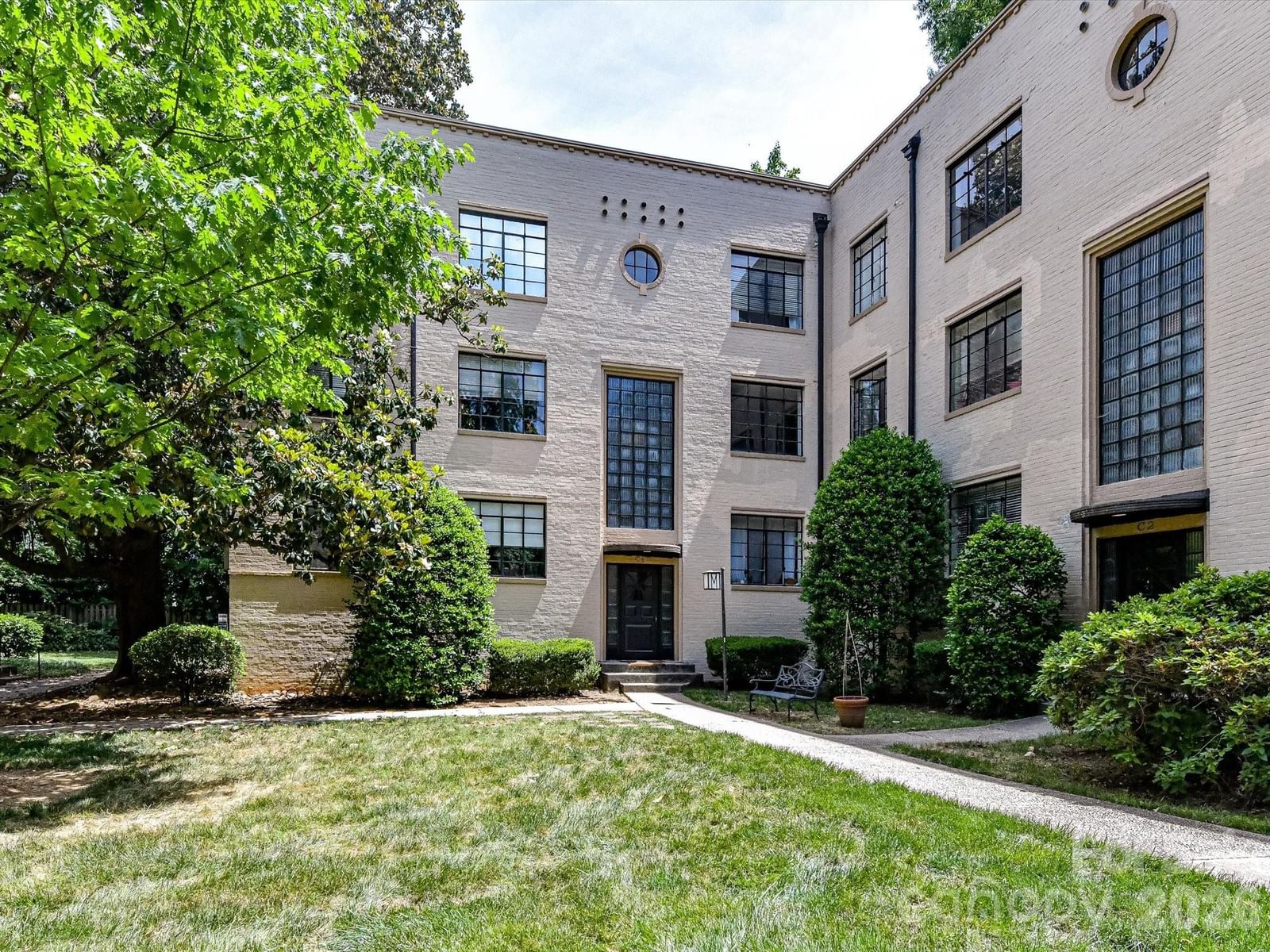
Housing in the core is mostly modern and low-maintenance. Buyers choose between amenity-rich mid- and high-rise condos and 2–3 story townhomes with garages and rooftop terraces, usually on very small lots. You give up yard space and gain convenience.
Here's where the overall market stands this fall:
Charlotte Housing Market Snapshot — September 2026
Headline numbers for young professionals weighing whether Charlotte still offers attainable urban living: prices are near $420K, homes are taking longer to sell, and price drops are common enough to create negotiating room.
The September numbers favor buyers. According to Redfin's September 2026 data, the median sale price of $419,800 is down 1.2% year over year. The median home sits for 58 days, and 40.4% of listings have taken a price drop. With a 98.3% sale-to-list ratio, there's real room to negotiate, especially on condos that have sat through a slow month.
Charlotte is still a selective market, though. A meaningful share of homes still sell above asking, and well-priced homes in popular neighborhoods go under contract faster than the median.
Are Home Prices in Charlotte, NC Still Rising?
Prices are still climbing over the long run, just more slowly. The steep pandemic-era run-up has given way to steadier, more predictable growth:
Charlotte Median Home Price Trend, 2022–2026
Charlotte’s median home price has continued to climb since 2022, though the pace has moderated from the pandemic-era surge—useful context for first-time buyers trying to time an entry point.
Charlotte’s median home price has continued to climb since 2022, though the pace has moderated from the pandemic-era surge—useful context for first-time buyers trying to time an entry point.
Annual gains since 2022 have stayed between 1.4% and 4.0%. This chart uses Opendoor's year-to-date median, so it won't match Redfin's single-month September figure above. The two come from different sources and cover different time periods. Read together, they describe a market that is rising over the year even though one month softened.
Charlotte also remains cheaper than its peer metros. Its $412,500 median compares with $450,000 in Nashville, $465,000 in Austin, and $560,000 in Denver. For relocating professionals, that gap often decides the move.
How Much Do Homes Cost in Charlotte, NC's Young-Professional Neighborhoods?
Location within the city matters a great deal. Here's how the most popular submarkets compare:
Median Home Values in Young-Professional Hotspots
A quick price comparison across some of Charlotte’s most active urban and near-urban submarkets, highlighting the premium for South End, Ballantyne, and Plaza Midwood versus more attainable University City.
A quick price comparison across some of Charlotte’s most active urban and near-urban submarkets, highlighting the premium for South End, Ballantyne, and Plaza Midwood versus more attainable University City.
•South End (~$525,000): You pay a premium for light rail access and the Rail Trail. Typical 2026 listings range from about $400K to $700K.
•Plaza Midwood (~$480,000): Eclectic and bar-heavy, with a mix of bungalows and new townhomes.
•NoDa (~$465,000): An arts district on the Blue Line. Typical listings run about $300K to $600K.
•University City (~$335,000): The most attainable option on the light rail, and popular with first-time buyers.
•Ballantyne (~$540,000): A corporate-campus suburb that appeals to buyers planning for a family.
Set your budget realistically. Buying at the metro median takes an annual income of roughly $113,000, with mortgage rates around 6.4%. If you'd rather rent first, two-bedroom apartments generally run $1,800–$2,400 per month.
What Do HOA Fees Typically Look Like in Charlotte, NC Condos and Townhomes?
HOA fees are the price of low-maintenance living, and they vary widely:
•Townhome communities:$200–$450/month
•Mid-rise condos:$300–$700/month
•Luxury high-rise condos:$600–$1,200+/month
When we review HOA documents with clients, the reserve fund is the first thing we check. A well-run association is funded at 70% or higher. Expect fees to rise about 3–5% per year, and know that some buildings have seen increases of 30–60% over five years. A low fee paired with thin reserves often ends in a special assessment.
What Are Typical Lot Sizes in Charlotte, NC's Urban Neighborhoods?
Lots are small by design. Zoning in Charlotte's denser residential districts allows detached homes on lots as small as 3,500 sq ft (R-8) or 3,000 sq ft (UR-1), compared with 10,000 sq ft in suburban R-3 areas. Townhomes and zero-lot-line homes often have no real yard at all. A rooftop terrace or small courtyard takes the place of a lawn.
Most young professionals see that as a plus. There's no mowing and no gutter cleaning. You can lock the door and leave for a weekend in the mountains (about 2–3 hours away) or at the coast (about 3–3.5 hours). Townhome supply has also grown, so buyers have more choice than they did a few years ago.
Where Do People Gather in Charlotte, NC? Key Landmarks and Social Hubs
Charlotte's social life centers on Uptown's parks and markets, South End's Rail Trail corridor, the major stadiums, and Camp North End. Most of these spots are a short walk, light rail ride, or scooter trip from one another.
What Are the Best Places to Hang Out in Uptown Charlotte, NC?
Romare Bearden Park serves as Uptown's front lawn. It draws lunch-hour crowds, outdoor fitness classes, summer concerts, and fans heading to a Knights game next door. A few blocks away, The Market at 7th Street is a public market with local vendors and coffee, where weekday regulars and weekend browsers mix.
Uptown's smaller green spaces fill in the rest. First Ward Park and Fourth Ward Park are quieter options for a morning walk with the dog.
What Is South End Charlotte, NC Known For?
South End is the city's social engine. Its dining and brewery corridor runs along South Boulevard and the Rail Trail, where converted warehouses now house taprooms, patios, and food halls. On a nice Saturday, the Rail Trail is packed with walkers, cyclists, and groups hopping between breweries. That energy is a big reason South End is widely considered Charlotte's top neighborhood for young professionals.
Which Sports and Entertainment Venues Are Near Downtown Charlotte, NC?
•Bank of America Stadium is home to the Carolina Panthers and Charlotte FC, and Uptown fills up on game days.
•Truist Field is home to the Charlotte Knights and offers one of minor league baseball's best skyline views.
A practical tip: event parking runs $25–$30, and towing or fines can top $500. Living within walking or rail distance of these venues saves real money over a season.
What Is Camp North End in Charlotte, NC?
Camp North End is a historic industrial complex that has been reinvented as a creative district, with food stalls, artist studios, pop-up markets, and outdoor event space. The crowd is a bit more relaxed than South End's. The district has also helped drive interest in the residential pockets just north of Uptown.
Retail demand is strong across all of these areas. Charlotte's retail vacancy sits at just 2.84%, and a 1.4 million sq ft construction pipeline means more restaurants and shops are coming.
How Is the Commute in Charlotte, NC? Light Rail, Highways, and Airport Access
The urban core is the only part of Charlotte where a car-light commute really works. The LYNX Blue Line, the I-277 loop, and the Rail Trail link Uptown and South End efficiently. Outside that corridor, commutes can stretch to 30–40+ minutes as the region keeps growing.
Which LYNX Blue Line Stops Serve Uptown and South End Charlotte, NC?
The LYNX Blue Line runs from UNC Charlotte–University City through NoDa, Uptown, and South End to I-485. The key stops for young professionals are:
•Charlotte Transportation Center (CTC): Uptown's central transit hub, with connections to buses and the CityLYNX Gold Line streetcar
•Carson Station: The gateway between Uptown and South End, a short walk from the stadium district
•Bland Street Station: The heart of South End's brewery and dining scene
Living near one of these stations is the most reliable way to avoid Charlotte's peak congestion, which runs roughly 3:00–7:00 p.m.
How Do Highways Connect Uptown Charlotte, NC to the Region?
The I-277 loop circles Uptown and connects directly to I-77 (north to Lake Norman, south to Fort Mill and Rock Hill) and I-85 (toward Concord and Gastonia). Lake Norman is about 30 minutes from Uptown. If you're considering a suburb, keep your search within a 25–30 minute commute radius to protect your sanity.
What Is the Rail Trail Pedestrian Bridge Over I-277 in Charlotte, NC?
For South End and Uptown residents, the Rail Trail pedestrian bridge is the most important mobility project underway. It will close the gap across I-277 and give walkers, cyclists, and scooter riders a continuous link between the two neighborhoods:
$23.8 millionProject Budget
Rail Trail Pedestrian Bridge Over I-277
A major South End/Uptown mobility project that strengthens the walk-bike connection across I-277—especially relevant for professionals who want car-light access to offices, nightlife, breweries, and the Rail Trail.
Project TypeBridges, Transportation
Project PhaseConstruction
Construction ContractorBlythe Construction
I-277 South off-ramp (Exit 1E) Closure StartAugust 17, 2026
The $23.8 million bridge ties into about 40 miles of connected bikeways and complements the 30+ mile Cross Charlotte Trail. Drivers should plan around construction: the I-277 South off-ramp to College Street (Exit 1E) closed on August 17, 2026, and is expected to reopen in late 2027. When clients compare South End condos, we point out that units near the bridge landing stand to gain the most once it opens.
How Will the Transit Tax Change Commuting in Charlotte, NC?
Mecklenburg County's approved transit funding plan will change how residents get around over the next decade. Here's how the money breaks down:
Transit Tax Funding Allocation
The approved Mecklenburg County transit funding plan splits most revenue between road upgrades and rail/mass transit expansion, with a dedicated share for buses, microtransit, sidewalks, and safety improvements.
TOTAL
Road Improvements
40%
Rail and Mass Transit Expansion
40%
Bus, Microtransit, Sidewalks, and Safety
20%
The approved Mecklenburg County transit funding plan splits most revenue between road upgrades and rail/mass transit expansion, with a dedicated share for buses, microtransit, sidewalks, and safety improvements.
With 40% going to rail and mass transit expansion and another 20% to buses, microtransit, sidewalks, and safety, buyers near current and planned transit corridors are well positioned. Rail proximity has historically supported resale value in South End and NoDa, and this funding makes that case stronger.
How Far Is Charlotte Douglas International Airport (CLT) From Uptown Charlotte, NC?
From Uptown, CLT is roughly a 15-minute drive in light traffic. That's one of the best airport commutes of any major U.S. city, and a real perk for consultants and finance professionals who fly every week. From the outlying suburbs, plan on 30–45 minutes.
Is Charlotte, NC a Good Place for Young Professionals to Buy?
If you want urban amenities without big-city prices, yes, and this fall is a good time to buy. Prices have flattened, homes are sitting longer, and many sellers are cutting prices. Meanwhile, job growth of 2.7% over 12 months and 3.4% unemployment keep long-term demand steady.
When we tour South End, NoDa, and Uptown with young professionals, we usually start with three questions:
1. Which rail stop do you want to be near?
2. What all-in monthly payment, including the HOA, are you comfortable with?
3. Do you plan to stay 3 years or 7+? The answer determines whether a condo or a townhome makes more sense.
Once you've answered those, Charlotte's urban core narrows quickly to a short list of buildings and blocks that fit the way you want to live.
Listings courtesy of Canopy MLS as distributed by MLS GRID
Based on information submitted to the MLS GRID as of Oct 19, 2026, 5:29 PM EDT. All data is obtained from various sources and may not have been verified by broker or MLS GRID. Supplied Open House Information is subject to change without notice. All information should be independently reviewed and verified for accuracy. Properties may or may not be listed by the office/agent presenting the information.
IDX information is provided exclusively for consumers' personal, non-commercial use and may not be used for any purpose other than to identify prospective properties consumers may be interested in purchasing. Information is deemed reliable but is not guaranteed by MLS GRID. Use of it may be subject to an end user license agreement prescribed by the MLS.
Properties displayed may be listed or sold by various participants in the MLS.
Some IDX listings have been excluded from this website.
Any use or search of the data on this website, other than by a consumer looking to purchase real estate, is prohibited.
Explore Charlotte, NC Neighborhoods
Dive deeper into the specific villages and communities that make Charlotte, NC unique.
Is Charlotte, NC a good place for young professionals who may start a family?
Charlotte, NC works well for young professionals who want urban amenities now and the option to move toward more family-oriented areas later. Uptown, South End, NoDa, and Plaza Midwood are best for a social, walkable lifestyle, while Ballantyne is a corporate-campus suburb that appeals to buyers planning for a family.
What types of condos and townhomes are common in Charlotte, NC’s urban core?
Charlotte’s urban core is known for modern, low-maintenance housing. Buyers typically choose between amenity-rich mid-rise or high-rise condos and 2–3 story townhomes with garages, rooftop terraces, and very small lots.
How much do homes cost in Charlotte, NC neighborhoods popular with young professionals?
Charlotte’s metro median sale price is about $419,800, with major neighborhood differences. South End is around $525,000, Plaza Midwood around $480,000, NoDa around $465,000, University City around $335,000, and Ballantyne around $540,000.
What are typical HOA fees for condos and townhomes in Charlotte, NC?
Townhome HOA fees in Charlotte commonly run $200–$450 per month. Mid-rise condos are typically $300–$700 per month, while luxury high-rise condos can range from $600 to $1,200+ per month. Well-run associations generally have reserve funding of 70% or higher.
Is Charlotte, NC walkable enough to live without a car?
Charlotte is not highly walkable citywide, with a Walk Score of 26/100 and Transit Score of 27/100. In the urban core, especially Uptown, South End, and areas along the LYNX Blue Line, a car-light lifestyle is much more realistic.
How does commuting work in Charlotte, NC for Uptown and South End residents?
The LYNX Blue Line connects University City, NoDa, Uptown, South End, and I-485. Key stops for young professionals include Charlotte Transportation Center, Carson Station, and Bland Street Station. Peak congestion typically runs from about 3:00–7:00 p.m.
How close is Charlotte Douglas International Airport to Uptown Charlotte, NC?
Charlotte Douglas International Airport is roughly a 15-minute drive from Uptown in light traffic. From outlying suburbs, the airport trip is typically closer to 30–45 minutes.
What should buyers know about schools when comparing Charlotte, NC neighborhoods?
School ratings and assignments are not specified for Uptown, South End, NoDa, Plaza Midwood, University City, or Ballantyne. Buyers comparing family-oriented options should verify the assigned school for each specific address before making a purchase decision.