Living in Belmont, NC: The Essential Guide for Young Professionals
Explore Belmont’s walkable historic downtown, $535K median homes, mill lofts, 25–35 min Uptown commute, and 15-min CLT access.
Written ByTristan Armstead
PublishedOctober 16, 2026
Armstead Realty Group is a Charlotte, NC real estate team helping buyers and sellers with finance-driven strategy, a 5% listing fee, and English, Spanish, and Tagalog service. Serving Charlotte, NC, Cramerton, NC, McAdenville, NC, Lowell, NC, Dallas, NC, Lake Wylie, SC, Mount Holly, NC, Pineville, NC, Fort Mill, SC, Monroe, NC, Tega Cay, SC, Harrisburg, NC, Gastonia, NC, Concord, NC, Huntersville, NC and Belmont, NC.
Belmont, NC
Region
Just across the Catawba River from Charlotte, Belmont packs a walkable historic downtown, beautifully restored textile mills, and a genuine social scene into a town about 15 miles from Uptown. People have noticed. The population climbed from 15,010 at the 2020 Census to an estimated 16,700 in 2026, roughly 11% growth in six years. A growing share of those newcomers are young professionals who decided they'd rather have this than another apartment tower in South End. Here's what daily life, housing, social hubs, and commuting actually look like in Belmont as of October 2026.
What is the vibe like in Belmont, NC for young professionals?
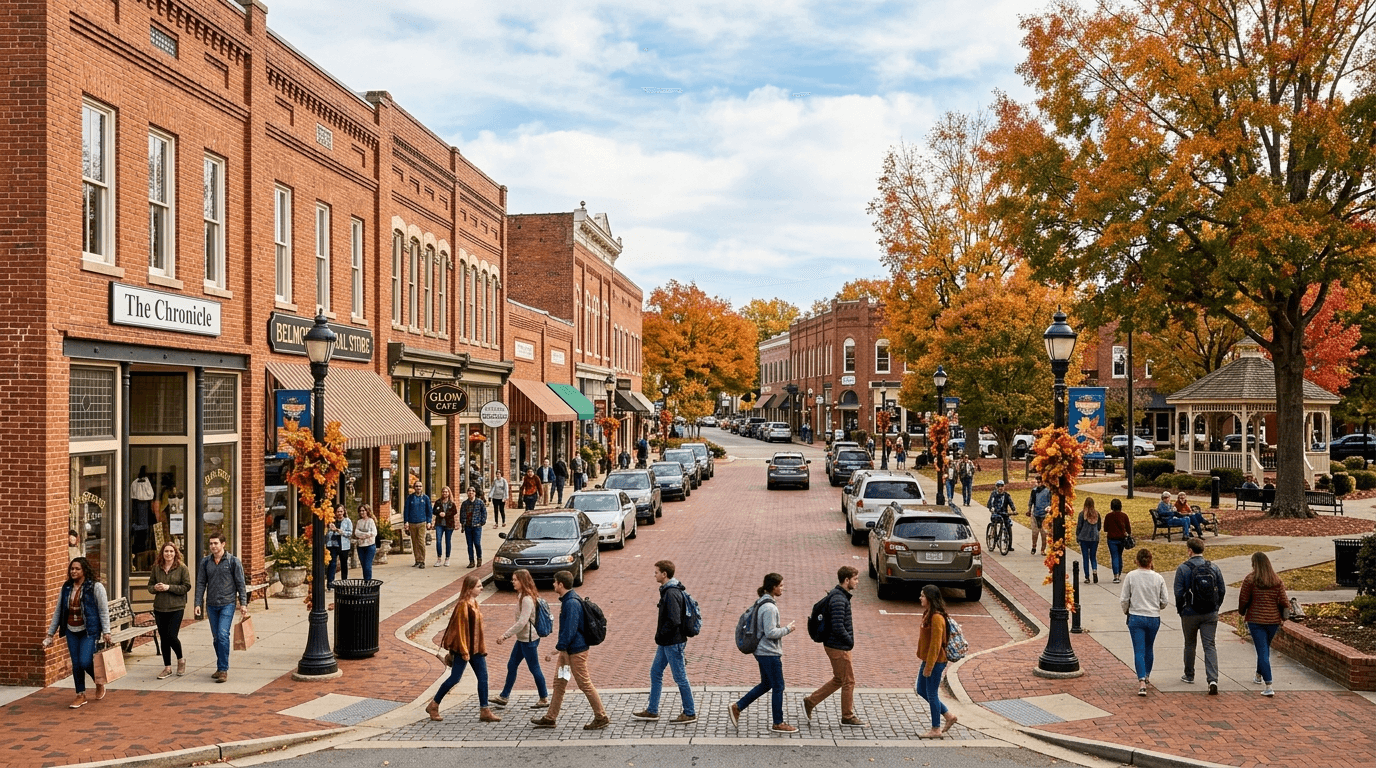
Belmont is lively and walkable, with a compact historic downtown, plenty of small-town character, and a social calendar that stays busy most nights and weekends. It's not a sleepy bedroom community, and it's not trying to be a big city. It lands comfortably in between.
Is downtown Belmont, NC walkable?
Absolutely. It's often the first thing buyers comment on when we tour homes near Main Street. The Downtown District is small, just 6.13 acres of dedicated downtown zoning, which means restaurants, craft beer spots, cocktail bars, coffee shops, and boutiques are all clustered within a few blocks.
The numbers back it up. Belmont has about 59 miles of existing sidewalk and 5.3 miles of multi-use paths and greenways. Its walk-to-work rate sits at 3.2%, compared with 1.4% regionally and 1.8% statewide. Those figures may look modest, but for a Charlotte-area suburb, they stand out.
And it's getting better. The city has a downtown pedestrian package that combines safety improvements with a rail-trail investment:
$8.8MTotal Planning-Level Estimate (2025 Dollars)
Downtown Pedestrian Infrastructure Package
A targeted downtown infrastructure initiative pairs safety improvements with a rail-trail investment—important context for buyers who value walkability, bike access, and a more connected urban core.
If walking to dinner, biking a greenway, or leaving the car parked on weekends matters to you, keep an eye on the rail-trail. Homes within walking distance of it are likely to become even more sought-after.
What is the social scene like in Belmont, NC?
For a town of roughly 16,000, there's a surprising amount happening. A typical calendar includes:
•Outdoor concerts and events at Stowe Park , the green space at the heart of downtown
•Seasonal festivals that close streets and pack Main Street
•Evening community runs and group fitness, fueled by a strong boutique gym scene
•Cultural events and concerts at Belmont Abbey College, which enrolled 1,741 students in fall 2025
How does Belmont, NC compare to living in Charlotte?
Charlotte wins on density and nightlife. Belmont offers something many of our clients value more: within a few weeks, you know the bartender, the barista, and your neighbors by name. It's also generally regarded as a safe town. Overall cost of living runs slightly higher than the national average, but housing is considered reasonable, and groceries, healthcare, and utilities are moderately priced.
What are condos, townhomes, and mill lofts like in Belmont, NC?
Young professionals in Belmont typically choose among three housing types: newer multi-story townhomes, adaptive-reuse mill lofts full of industrial character, and a growing supply of modern apartments. Most require little to no yard work.
What does a home cost in Belmont, NC right now?
Belmont's market sits in the low-to-mid $500Ks, and well-priced homes still move quickly:
Belmont 2026 Housing Market Snapshot
Headline buying metrics for Belmont as of late 2026: prices sit around the low-to-mid $500Ks, with tracked closings showing a fast median 11-day path from listing to contract.
•Median sold price:$535,000, or about $248/sq ft, across 234 tracked closings
•Market speed: a median of 11 days from listing to contract and 39 days from contract to closing
What this means for you: desirable homes near downtown still go under contract fast. Get pre-approved early, and be ready to act when the right one appears.
What price range should a young professional budget for in Belmont, NC?
Most of the action happens in the middle of the market:
Where Belmont Homes Are Selling: Last 6 Months
Closed sales are concentrated in the $425K–$605K tier, a useful guide for young professionals budgeting for a move-up purchase near Charlotte.
Closed sales are concentrated in the $425K–$605K tier, a useful guide for young professionals budgeting for a move-up purchase near Charlotte.
The $425K–$605K tier led with 78 sales, followed by $245K–$425K with 63 sales. That lower tier is where first-time buyers can still find townhomes and older homes. A few neighborhood reference points:
•Eagle Park (downtown):$470,000 to $740,000, with a median of $615,000
•Belmont Historic District: fixer-uppers from the high $200s, with renovated homes reaching around $700,000
•New construction: Stowe Pointe from the $480s and South Point Village from the $510s
•Lake Wylie access: McLean Overlake from the $450s
What architectural styles will I find in Belmont, NC?
Whenever we walk clients through the mill properties, it's the exposed brick and original timber that win them over. Belmont's adaptive-reuse mill lofts, such as those at Chronicle Mill, typically feature:
•Exposed brick walls and heavy timber beams
•Soaring ceilings and oversized factory windows
•Clean, modern finishes like polished concrete, open kitchens, and matte black fixtures
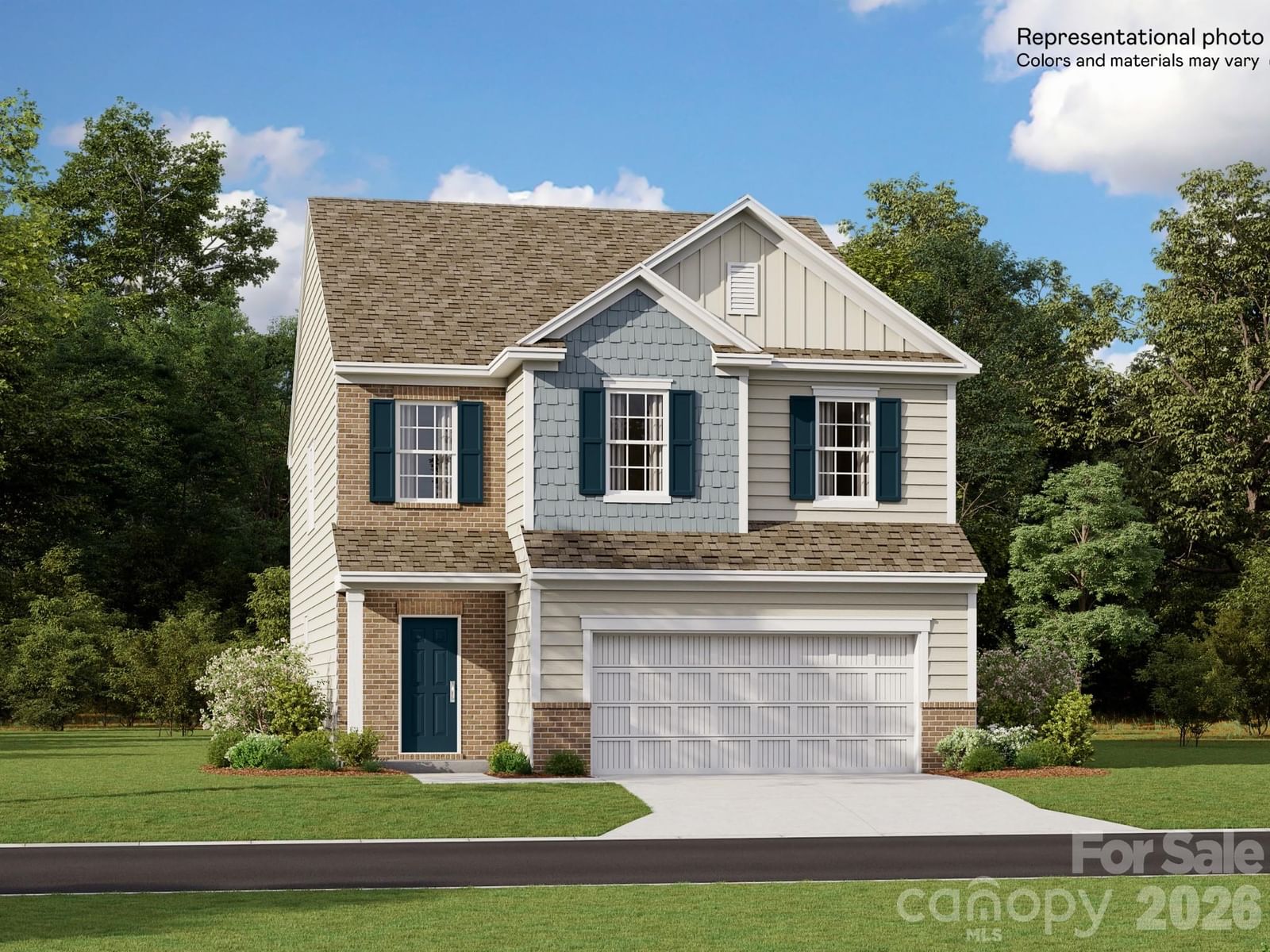
The newer townhome communities take a different approach. They're usually two to three stories, with ground-floor garages, open main levels, and small patios or balconies instead of yards.
What are typical lot sizes in Belmont, NC?
That depends heavily on the neighborhood:
•Downtown and mill-area townhomes and condos: little or no private yard, a good fit for frequent travelers and anyone working long hours
•Historic district bungalows and mill houses: modest, narrow lots on tree-lined streets
•Suburban and new-construction communities: standard subdivision lots
•Rural residential areas: roughly 1,356.8 acres zoned Rural Residential, for buyers who want room to spread out
With tree coverage of about 47.51%, even Belmont's compact lots tend to feel shaded and green.
Should I rent or buy in Belmont, NC?
Renting is a smart way to test-drive the town. Apartment rents averaged about $1,655 as of July 2026, still below the national average:
Average Apartment Rent Trend: Belmont vs. National
Belmont apartment rents have remained below the national benchmark, with local rents moving from $1,538 in Nov. 2023 to $1,655 in Jul. 2026.
Belmont
National
Belmont apartment rents have remained below the national benchmark, with local rents moving from $1,538 in Nov. 2023 to $1,655 in Jul. 2026.
Rental supply has expanded, too. 554 rental units were built between 2010 and 2019, and projects like Artisan Crossing added another 250 multifamily units.
What do HOA fees and property taxes look like in Belmont, NC?
•Property tax: the combined rate is about $1.05 per $100 of assessed value (Gaston County 59.9¢ plus City of Belmont 45.5¢). On a $500K home, that's roughly $5,250 a year.
•HOA fees: these vary by community. In the Belmont Community Association, for example, combined monthly assessments for townhome sections run about $214.56, while detached sections climb as high as $446.08. Always request the HOA budget and fee history before making an offer.
Where do people gather in Belmont, NC?
Main Street and Stowe Park anchor Belmont's social life, while the river, the Whitewater Center, and Daniel Stowe Botanical Garden take care of outdoor weekends.
What are the best restaurants and bars in downtown Belmont, NC?
Downtown is the go-to for after-work drinks, weekend brunch, and first dates. The String Bean is a dependable choice for live music and a laid-back drink. A short stroll away, you'll find:
•Craft breweries and taprooms
•Speakeasy-style cocktail bars and wine bars
•Upscale steakhouses and Southern comfort food
Clients moving from Charlotte often expect slim pickings in a town this size. Most are pleasantly surprised by how much sits within walking distance.
Where do locals go on weekends in Belmont, NC?
•Stowe Park: farmers markets, concerts, and picnics right downtown
•Rocky Branch Park:175 acres with a 1.2-mile trail and some of the best mountain biking near Charlotte
•Daniel Stowe Botanical Garden:380 acres of gardens and walking paths, with adult admission at $18.95
•U.S. National Whitewater Center: a quick drive for rafting, climbing, trail running, and outdoor concerts
•The Catawba River and Lake Wylie: paddling, boating, and waterfront dining
Is Belmont, NC good for fitness and an active lifestyle?
Very much so. Belmont offers CrossFit boxes, Pilates studios, boot camps, and larger gyms. Add in the trails, greenways, and the nearby Whitewater Center, and staying active outdoors is easy.
How is the commute from Belmont, NC to Charlotte?
Most residents drive. Uptown Charlotte is typically 25–35 minutes away by car, and Charlotte Douglas International Airport is just 15–20 minutes. Belmont has no light rail or commuter train station, so CATS express bus service is the main public transit option.
Regional Commute Times from Belmont
Belmont’s appeal for urban-oriented professionals is its small-city lifestyle with quick access to Charlotte job centers, the airport, and nearby Gaston County hubs.
How long does it take to drive from Belmont, NC to Uptown Charlotte?
Uptown is about 15 miles away: 18 to 25 minutes in light traffic, closer to 25–35 minutes at rush hour. South End runs 30–40 minutes. Most commuters take one of two routes:
•I-85 North across the Catawba River into West Charlotte and Uptown. NCDOT's $634.8 million I-85 widening project near North Belmont should add capacity over time, though construction delays are part of the deal for now.
•US-29/74 (Wilkinson Blvd): a surface-street alternative that passes the airport on its way into West End and Uptown
How close is Belmont, NC to the Charlotte airport?
Remarkably close. CLT is about 7 miles away, roughly 15 minutes in normal traffic. That proximity is a major draw for consultants, sales reps, and other frequent flyers. Many of our buyers who travel weekly tell us the short airport run is what sealed the decision.
Is there public transit or a train from Belmont, NC to Charlotte?
Belmont has no light rail or commuter rail stop, and the LYNX Blue Line doesn't reach Gaston County. Your transit options are:
•CATS 85X Gastonia Express: an express bus along the I-85 corridor into Uptown, with a one-way fare of $2.60
•Park-and-ride: some commuters drive to a CATS park-and-ride and bus the rest of the way
Realistically, you'll want a car. Among Belmont renters, about 1,433 drive alone to work, compared with 106 who carpool. Another 190 work from home, a number that keeps rising as hybrid schedules become the norm.
What other nearby hubs are easy to reach from Belmont, NC?
•Mount Holly: about 10 minutes
•Gastonia: about 15 minutes (roughly 10 miles)
•Cramerton and McAdenville: right next door, with McAdenville famous for its "Christmas Town" lights every December
Is Belmont, NC a good place for young professionals to live?
Yes, particularly if you want a walkable, social downtown, homes with real character, and a quick drive to both the airport and Uptown, without the density of Charlotte. The trade-offs are real: you'll need a car, and homes near downtown still sell fast, so come prepared. Before you decide, spend a Friday evening on Main Street, tour a mill loft, and drive the I-85 commute at rush hour. You'll know pretty quickly whether Belmont fits.
Listings courtesy of Canopy MLS as distributed by MLS GRID
Based on information submitted to the MLS GRID as of Oct 19, 2026, 4:22 PM EDT. All data is obtained from various sources and may not have been verified by broker or MLS GRID. Supplied Open House Information is subject to change without notice. All information should be independently reviewed and verified for accuracy. Properties may or may not be listed by the office/agent presenting the information.
IDX information is provided exclusively for consumers' personal, non-commercial use and may not be used for any purpose other than to identify prospective properties consumers may be interested in purchasing. Information is deemed reliable but is not guaranteed by MLS GRID. Use of it may be subject to an end user license agreement prescribed by the MLS.
Properties displayed may be listed or sold by various participants in the MLS.
Some IDX listings have been excluded from this website.
Any use or search of the data on this website, other than by a consumer looking to purchase real estate, is prohibited.
Frequently Asked Questions
Is Belmont, NC a good place to live for young professionals and families?
Belmont, NC offers a walkable historic downtown, a busy social calendar, and access to parks, trails, the Catawba River, and Lake Wylie. It is generally considered a safe town and sits about 15 miles from Uptown Charlotte, making it appealing for residents who want small-town character near the city.
What types of condos and townhomes are available in Belmont, NC?
Belmont, NC has newer multi-story townhomes, adaptive-reuse mill lofts, and modern apartments. Townhomes are usually two to three stories with garages, open main levels, and small patios or balconies, while mill lofts often feature exposed brick, heavy timber beams, tall ceilings, and oversized factory windows.
How much do homes cost in Belmont, NC?
Belmont, NC had a median sold price of $535,000, or about $248 per square foot, across 234 tracked closings. The busiest price tiers were $425,000–$605,000 and $245,000–$425,000, where some townhomes and older homes can still be found.
Are HOA fees and property taxes expensive in Belmont, NC?
Belmont, NC has a combined property tax rate of about $1.05 per $100 of assessed value, including Gaston County and City of Belmont taxes. On a $500,000 home, that equals roughly $5,250 per year. HOA fees vary by community, with one townhome example showing combined monthly assessments of about $214.56.
How is the commute from Belmont, NC to Charlotte?
Most Belmont, NC residents drive to Charlotte. Uptown Charlotte is about 15 miles away and typically takes 18–25 minutes in light traffic or 25–35 minutes during rush hour. South End is usually about 30–40 minutes away.
Does Belmont, NC have public transportation to Charlotte?
Belmont, NC does not have a light rail or commuter rail station, and the LYNX Blue Line does not extend into Gaston County. The main transit option is the CATS 85X Gastonia Express bus along the I-85 corridor into Uptown, with a one-way fare of $2.60.
What schools or colleges are in Belmont, NC?
Belmont, NC is home to Belmont Abbey College, which enrolled 1,741 students in fall 2025. The college adds cultural events and concerts to the local calendar, contributing to Belmont’s social and community life.